

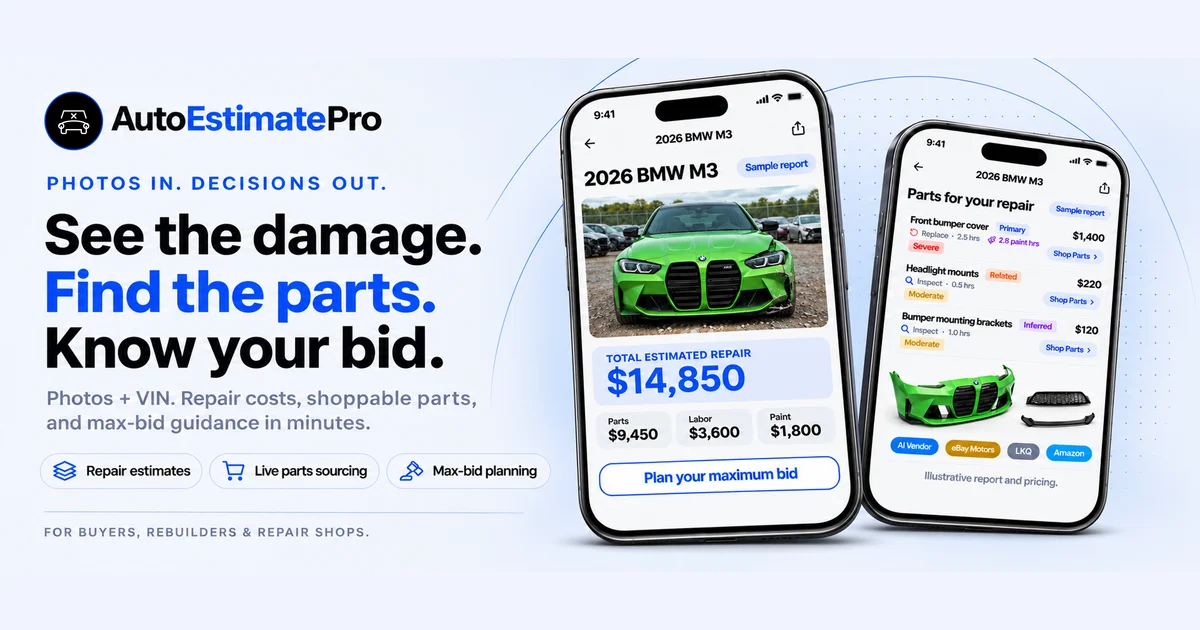
A useful photo repair estimate is a starting document for a decision, not a final promise about a car. It should help you identify the visible problem, separate confirmed facts from open questions, organize parts and labor assumptions, and prepare a productive conversation with a repair professional. The most useful number is not necessarily the smallest total. It is the total whose scope, evidence, exclusions and next steps you can explain.
This guide follows one job from the first photos through estimate comparison, parts research, a possible supplement and the final handoff. It includes original planning worksheets and fictional examples you can adapt. The examples are arithmetic demonstrations, not market prices or predictions. AutoEstimatePro publishes this guide and offers paid preliminary reports; the explanations also work if you prepare your notes without buying a report.
1. Choose the decision before you ask for a number
Start by finishing this sentence: “I need this estimate so I can decide whether to ____.” A vehicle owner arranging a repair, a buyer comparing two damaged vehicles, and a shop screening a photo enquiry have different decisions. An estimate can be well organized and still answer the wrong question. If you need a repair appointment, an elaborate resale scenario is a distraction. If you are considering a purchase, a repair subtotal without acquisition expenses is incomplete.
For an owner, the initial decision might be whether to request a hands-on assessment, how to describe the problem, or how to compare the written proposals already received. Write down your immediate constraint as well. You may need the vehicle for work, have limited storage, or be unable to wait for a particular part. These facts do not change the damage, but they can change which next step is practical. Tell the shop about them before treating an approximate completion date as a commitment.
For a buyer, distinguish three separate gates: permission to buy or register the vehicle, the technical feasibility of an appropriate repair, and the financial feasibility of the project. A favorable result at one gate does not settle the others. A low parts subtotal cannot resolve an uncertain title, and a valid title cannot confirm that the photographed repair is straightforward. Keep those decisions on separate lines so a persuasive price does not quietly erase a missing prerequisite.
For a professional evaluating a lead, define what the first response can responsibly promise. A photo review may identify areas needing inspection, request missing evidence, or explain the estimate process. It should not silently become authorization to perform work. The next useful outcome can be a booked assessment with clear expectations, rather than a supposedly final price issued before anyone sees the vehicle.
A compact decision statement might read: “I want a written scope for the front corner repair, a list of items requiring inspection, and an explanation of any costs excluded from the first quote. I am not authorizing parts orders today.” This gives every participant the same starting point. Update the statement when the decision changes; do not reuse a purchase-planning document as a completed-repair certificate.
2. Build an evidence packet another person can understand
A useful photo set tells a story in three distances: the entire vehicle, the affected area in context, and the specific visible damage. A close-up alone can be difficult to locate. A wide shot alone may conceal the very detail that matters. Label the sequence in ordinary language, such as “front right corner, wide view” and “same corner, lamp mounting area.” Consistent labels save a reviewer from guessing which side or component they are looking at.
Photograph only what you can access safely and are authorized to share. Do not lift a vehicle, remove a restraint component, touch high-voltage equipment or enter an unsafe area to improve an online estimate. If the necessary view is unavailable, record that limitation. “Underside not inspected” is useful evidence about the boundary of the review. A blank space is dangerous when someone later interprets it as confirmation that nothing is wrong.
Keep the original images as well as the set you submit. Avoid filters, decorative overlays and crops that remove surrounding context. If a photo is dark or blurred, describe what you could not capture instead of guessing. When a listing supplies the pictures, note the listing date and whether you have independently seen the vehicle. A photo copied from a seller is evidence of what was shown, not proof that the vehicle is still in the same condition.
Add a short written observation for symptoms the photos cannot communicate. Use descriptions rather than diagnoses: “a warning appeared after the impact” is different from “the sensor is broken.” Record when the symptom appeared, whether it existed before the incident, and whether anyone has already inspected it. Do not create new symptoms by driving or operating a potentially damaged vehicle just to complete the form. A qualified professional should decide what checks are appropriate.
Keep personal information out of the packet unless the intended recipient needs it. Review the background for people, mail, payment cards and location details. A VIN may be necessary for vehicle-specific work, but a public social post does not need every document you send privately to a shop. Separate public examples from the actual job file. Permission to discuss a repair does not automatically include permission to publish someone else's photographs.
Finally, include an evidence inventory: six exterior photos, two detail photos, a visible vehicle identifier checked against documents, and three unavailable views. This simple count helps detect missing attachments. It also lets you update the packet without confusion: “Version two adds the right-side detail; the earlier rear view remains unchanged.” Evidence quality improves through organization, not merely through a larger number of pictures.
3. Check identity and configuration before comparing parts
The first matching part photograph is not enough to identify the correct replacement. Begin with the vehicle identity, then record the configuration details relevant to the damaged area. Year, make, model, body style and available identification information are starting points. Trim, lighting, sensors, connectors, production changes and equipment packages may matter to a specific component. If you do not know an option, label it unknown rather than selecting the nearest familiar answer.
NHTSA's VIN decoder provides manufacturer-reported information associated with a VIN. Use it as an identity reference, while recognizing that it is not a complete vehicle-history search or a fitment guarantee. Compare the entered characters against the actual vehicle and available paperwork. Resolve a mismatch before attaching an estimate or parts order to that identity.
Create a short configuration note for each expensive or variant-sensitive item. For a mirror, your note might ask about side, connector, finish and camera or warning-system equipment. For a lamp, it might ask for the original part number and whether the replacement includes required modules. These are questions for the seller or repairer to answer for the actual vehicle. They are not a universal checklist proving interchangeability.
Watch for assemblies whose attractive advertised price covers only part of the required unit. A listing may show a complete-looking component while excluding a bracket, harness or control module. Conversely, a complete assembly may include something already quoted separately. Ask what is included in writing. Give each candidate a plain-language description of its contents; that makes it possible to compare a bare housing with a complete unit without treating them as equivalent products.
Keep identity, history and recall questions distinct. The NHTSA recall page distinguishes VIN-specific unrepaired-recall searches from general year, make and model results, and describes the limits of its coverage. A model campaign in a report does not establish whether an individual vehicle has an unrepaired recall. Save the relevant lookup date and follow the official instructions for that vehicle; do not use a clear photo or a clean-looking dashboard as a substitute.
This identity step is a practical way to prevent wasted comparison work. It is better to postpone an apparently excellent deal while a part number is confirmed than to build the rest of the budget around an incompatible item. When confirmation arrives, record who supplied it and what information they used. A copied seller title is weaker evidence than a documented answer addressing your actual configuration.
4. Read evidence, proposed action and price as separate fields
An estimate line contains several ideas that are easy to collapse into one. The component name identifies the subject. The evidence describes what was observed or inferred. The proposed action says what the estimator thinks might be required. The amount attaches a cost assumption to that action. Read those fields separately. A precise-looking price does not strengthen weak evidence, and a visible defect does not by itself establish the final repair method.
Use three evidence labels in your own notes: visible in the submitted material, reported by someone else, and unresolved pending inspection. You can also preserve the report's original labels, such as primary, related or inferred, alongside your plain-language explanation. Never change an inferred item into a confirmed finding merely because it appears in a table. Ask what observation would confirm or rule out that item, and who can reasonably make that observation.
Separate repair, replace and inspect actions. An inspect line is not a promise that a component needs replacement. A replace suggestion may change after professional examination. A repair suggestion may depend on material, damage location or a procedure that the image cannot establish. Your role as a reader is to carry those assumptions forward, not to settle technical questions from a thumbnail. Ask the repair professional to explain the relevant evidence and procedure.
Pay special attention to a zero amount. It may mean that no reliable price has been assigned, that an operation is grouped elsewhere, or that a particular cost does not apply. Those meanings have very different consequences. Add a note saying which interpretation is supported. If you cannot determine it, keep the line unresolved. The arithmetic sum can be correct while the practical budget remains incomplete.
Preserve exclusions with the same prominence as included work. If transportation, diagnostic work, paint materials, taxes or a hidden area are outside the scope, put those exclusions near the total. A footnote that disappears when a screenshot is shared does not help the next reader. When you discuss the estimate with someone else, send the scope and exclusions together rather than forwarding only the headline amount.
A useful reading sequence is evidence first, action second, amount third, and unresolved work last. Then return to the total. This takes longer than comparing two big numbers, but it produces better questions. You can say, “This proposal includes a lamp assembly and the other includes only the housing,” instead of arguing about which estimate is simply right.
5. Build a cost map with known, provisional and excluded items
Create three cost columns. “Quoted” contains a dated, scoped amount from the relevant provider. “Provisional” contains your planning assumptions. “Not yet priced” lists missing amounts without converting them to zero. A fourth notes column can record exclusions. These categories are more useful than a single confidence percentage because they explain what must happen to improve the budget.
Start with the repair itself: parts, body or mechanical labor, refinishing labor, materials, applicable diagnostics, measuring or calibration, and any other operations the repairer identifies. Then create a separate group for the logistics of obtaining and completing the repair, such as towing, transport or storage. If the vehicle is a proposed purchase, acquisition expenses belong in a third group. Keeping the groups separate prevents a repair estimate from being mistaken for the all-in cost of ownership or purchase.
Every provisional amount should have a reason and a replacement step. “Paint allowance entered for planning; request a scoped refinish quote” is useful. “Miscellaneous, $500” is difficult to evaluate. A general reserve may still be sensible as a personal planning choice, but it should remain visibly separate from specific quoted work. Do not describe it as a statistically validated hidden-damage prediction unless you actually have the evidence to support that claim.
Decide how you will handle tax, shipping and discounts before adding lines together. A supplier may display a price before shipping while a shop quote includes delivery. One line may include tax and another may not. Mark the basis on each entry. Compare totals only after making the accounting treatment consistent, and verify the actual amounts with the responsible provider. This is bookkeeping discipline, not a claim that a particular tax rule applies everywhere.
Record timing alongside money. A part priced today may be unavailable when the repair is authorized. A cheaper option may arrive later than the appointment. Ask the provider how long the quote is valid, whether stock is confirmed, and what happens if the item is wrong or delayed. A useful cost map shows which assumptions can expire before the decision is made.
Your initial result may deliberately remain incomplete. For example: “Confirmed and provisional repair lines total $2,450; diagnostics and transport are not priced.” That is more informative than showing $2,450 as an unrestricted project total. Incomplete information is not a failure of the worksheet. Hiding incompleteness is the failure the worksheet is designed to prevent.
6. A complete fictional example: from $2,450 to a scoped budget
Consider a fictional owner whose photos show damage around a front corner. The vehicle, quantities and prices below are invented for arithmetic practice. They do not describe an actual customer's report, a typical repair, or what your car should cost. The owner is preparing for a shop assessment and has not authorized work. The first document includes a component candidate, estimated labor, refinishing and a small hardware allowance.
| Initial planning item | Illustrative amount | Evidence status |
|---|---|---|
| Replacement component candidate | $900 | Fitment and included pieces unconfirmed |
| Body labor allowance | $720 | Hours and rate provisional |
| Refinish labor and materials | $650 | Panel scope requires shop review |
| Clips and small hardware | $180 | Allowance, not an ordered list |
| Initial repair subtotal | $2,450 | Contains unresolved assumptions |
The owner first corrects the component comparison. The $900 candidate excludes a required piece; a provider quotes $1,050 for the scoped package. The difference is $150. This is a change in included contents, not evidence that the initial document was uniformly fifteen percent low. The owner replaces the original line with $1,050 and keeps a note explaining the change. The revised subtotal becomes $2,600.
Next, the shop explains that the proposed refinishing scope is different from the allowance. In this invented example, the revised paint amount is $800, adding another $150. The subtotal becomes $2,750. The owner does not generalize that difference into a claim about every shop or every paint process. It is simply a documented revision to this particular hypothetical scope.
A separately quoted diagnostic or verification operation adds $240, producing $2,990. A delivery charge of $85 was not included in the component quote, so the working repair budget becomes $3,075 before any amounts still excluded. If tax remains unconfirmed, the worksheet continues to say so. Nothing about the calculation establishes that the vehicle is safe, that hidden areas are undamaged, or that all necessary operations have been identified.
The owner chooses a separate $500 personal reserve for unresolved work. The planning envelope is now $3,575 plus any explicitly excluded amounts. That reserve is not a repair line and does not authorize the shop to spend it. It is the owner's budgeting choice. If the owner cannot tolerate a larger outcome, the sensible next step may be to obtain more inspection evidence before committing, not to pretend the reserve caps the technical risk.
Suppose authorized inspection later identifies a $300 operation. If that operation is the uncertainty the reserve was intended to cover, the owner can move $300 from reserve to confirmed scope, leaving $200 reserved. The envelope stays $3,575. If the new work is outside the reserve's purpose, it needs a separate decision. This is why the reserve needs a written description rather than an unexplained percentage.
The lesson is a reconciliation method: replace an assumption with a verified line, explain the difference, update the total once, and preserve unresolved items. Do not add the complete new quote on top of the old allowance. Do not leave both a bare component and its complete replacement assembly in the total. Clear versioning prevents those mistakes and makes a supplement discussion much less confusing.
7. Compare parts by delivered scope, not thumbnail price
For each serious replacement candidate, record the seller, listing date, identifier, stated condition, included components, availability, delivery cost and return terms. Keep a link or a permitted copy of the relevant listing details. A screenshot of a price without the product description is a poor record if the listing changes. Avoid recording payment information in the estimate worksheet; the worksheet is for comparison and verification.
Ask whether the item is new, used, remanufactured or another described condition, and use the seller's actual wording. Then ask the repairer whether that specific candidate is appropriate for the planned work. A category is not a universal quality ranking. The useful comparison is between documented options for a particular application, including compatibility, condition, included pieces and the requirements of the repair.
Consider two fictional listings. Candidate A is $420 plus $95 delivery and needs a separate $80 bracket. Candidate B is $560 delivered with that bracket included. Before any other charges, A totals $595 and B totals $560. The cheaper headline is the more expensive comparable package in this example. The conclusion is limited to the stated assumptions; warranty, fitment, availability and return conditions still need review.
Now suppose A can arrive this week and B has no confirmed dispatch date. The price comparison is still correct, but the decision has another dimension. Ask how a delay would affect the appointment and whether you would incur transport, storage or replacement-vehicle costs. Do not turn an unverified delivery estimate into a guaranteed completion date. Keep the financial comparison and scheduling risk visible at the same time.
Before ordering a customer-supplied part, ask the shop about its policy. Will it install the item, inspect it first, or decline certain categories? Who handles a wrong or defective component? Which labor or warranty obligations apply? Obtain the actual policy instead of assuming that every shop treats owner-supplied parts the same way. A low purchase price can become an expensive mistake if no one agreed to the installation arrangement.
If you use AutoEstimatePro's sourcing links or AI Part Finder, treat them as research leads. Confirm the vehicle configuration, part number and seller statements before buying. Keep the identification question separate from the purchase question: recognizing a likely component does not confirm the condition or compatibility of a particular listing. Report-linked sourcing and a standalone part-photo search also begin with different inputs.
Close the loop after selection. Mark the chosen candidate, record the reason, and archive the rejected options without deleting the comparison. If stock changes, you can revisit the alternatives while retaining the original reasoning. This is especially helpful when several people are discussing the repair and one person sees a replacement listing that looks similar but contains different equipment.
8. Read labor, refinishing and overlap without prescribing a repair
A labor line is not merely an hourly rate multiplied by an obvious amount of work. It describes an operation, an estimating basis and assumptions about what is included. Ask the shop to explain those assumptions in plain language. Two quotes can use different rates and still differ mainly because they include different work. A rate comparison alone cannot tell you whether the scopes match.
Make a simple operation map: remove or gain access, perform the proposed repair or replacement, refinish where applicable, reinstall related items, and verify the result using the appropriate procedures. This is a discussion outline, not a repair sequence for you to perform. The technician determines the actual method. Your map helps identify which part of the job each estimate line is intended to cover.
Ask about apparent overlaps rather than deleting them yourself. An item that looks duplicated may represent a distinct task, while a bundled operation may already include something shown separately elsewhere. Write the question precisely: “Does line twelve include the access operation described on line seven?” The answer should identify the scope of each line. An unexplained demand to remove labor because it sounds repetitive is unlikely to clarify the estimate.
Refinishing deserves the same careful reading. Record which panels or surfaces are included, what preparation and materials are described, and what remains conditional on examination. Do not infer a paint method from the color visible in a photograph. Ask the repairer how they determined the proposed scope and how a change would be documented. A paint amount without an identified scope is difficult to compare with another quotation.
If you adjust an hourly rate in a planning tool, preserve the original and revised assumptions. For instance, changing a fictional eight-hour allowance from $90 to $105 per hour changes that line from $720 to $840, a $120 difference. It does not establish that eight hours is the correct scope. Rate sensitivity is a useful calculation only when it is kept separate from the question of which operations and hours apply.
Ask how subcontracted work appears in the estimate. A shop may coordinate another provider for an identified service. You need to know what has been quoted, what remains provisional, and how any revision will be communicated. Do not assume a separate provider's charge includes every associated logistical step. The goal is a written, understandable scope that the responsible repair business can explain.
9. Keep diagnostics and calibration vehicle-specific
Modern vehicle repair questions often extend beyond the visible panel. A camera, sensor, restraint system, mounting location or related component may create questions about inspection, diagnostics or calibration. The correct response is to ask which manufacturer procedures apply to the actual vehicle and proposed operation. It is not to assume every impact requires the same work, or that a lack of visible damage rules the work out.
I-CAR's OEM calibration requirements resource organizes information derived from manufacturer material and explicitly directs users to current vehicle-maker technical information. It is a starting reference with coverage limits. Ask the shop how it identifies the current procedure, who performs any required work, and what completion documentation it supplies. Do not treat a general online article as a substitute for vehicle-specific instructions.
Use a question sheet rather than a repair recipe. Which relevant systems are present? Which proposed operations trigger additional checks under the applicable procedure? Is specialist equipment or outside work required? What prerequisites must be satisfied before verification? How will the result be recorded? These questions let the qualified professional explain the process without asking you to diagnose or calibrate anything from a phone.
Be careful with phrases such as “the light is off” or “the screen looks normal.” They are observations, not complete proof of system condition. Record what was observed and who observed it, then ask what verification is appropriate. Likewise, a code or warning should not be converted into a component replacement conclusion without the relevant diagnosis. The estimate should preserve the distinction between a reported symptom and a confirmed repair requirement.
High-voltage systems, restraints and structural concerns need particular care. Do not touch, dismantle, energize or test potentially damaged equipment to resolve an online estimate question. Describe the limitation and seek qualified assistance. If a vehicle's condition raises an immediate safety concern, follow appropriate emergency guidance and professional advice rather than continuing a photo session. A financial planning guide cannot determine whether a particular damaged vehicle is safe to approach or operate.
Budget for verification as identified work, not an afterthought to be removed just to reach a target. If the scope is uncertain, show it as unpriced or provisional and identify the next qualified assessment. This protects the clarity of the estimate. It does not promise that adding a generic diagnostic line makes every repair complete or that a preliminary report can certify the final result.
10. Give the shop a concise handoff, not a demand to match a total
Prepare a one-page cover note for the evidence packet. State the vehicle, the decision you need help making, the visible concern, any reported symptoms, and the questions you could not resolve. Attach the full preliminary report if you have one. Highlight the uncertain lines instead of presenting the document as a challenge the shop must beat. You are asking for a scoped professional explanation, not asking someone to approve an algorithm's number.
A useful opening message is: “I have organized the photos and a preliminary estimate. Could you inspect the vehicle and explain which scope you agree with, which items change, and what cannot be priced yet? Please tell me the assessment process and any charges before we arrange it.” This is an example for an owner to adapt; it is not a message sent by AutoEstimatePro or an authorization to book or purchase anything.
Keep the first set of questions short enough to answer. Ask about the inspection or assessment arrangement, what documents to bring, the basis of the written estimate, parts choices, timing assumptions and how additional work is approved. Save detailed line reconciliation for after the shop has enough evidence. Sending a long list of presumed diagnoses before inspection can make the exchange harder rather than more informative.
The FTC's Auto Repair Basics recommends asking about pricing and obtaining a written estimate that identifies the condition, parts and anticipated labor, with an approval arrangement for additional work. It also encourages understanding the repair warranty. Local requirements and the actual agreement matter, so confirm the process with the shop and the appropriate consumer authority when necessary.
Document the shop's answers without rewriting them into stronger promises. “Part availability will be checked after inspection” is not “the part is available.” “We can assess it Tuesday” is not “the repair will be finished Tuesday.” Preserve the distinction in your own notes, especially if a family member, insurer or business partner is helping coordinate the job.
At the end of the conversation, repeat the next agreed step: who will inspect, what is authorized, what remains unapproved, what information is missing, and when an update is expected. If the answer is “we need to inspect before quoting,” that can be a sensible outcome. The purpose of the preliminary packet is to improve the next decision, not to force certainty before the necessary evidence exists.
11. Reconcile two quotations using a scope bridge
A scope bridge explains the difference between two totals one cause at a time. Put the quotes beside each other, match equivalent operations, and identify unmatched lines. Begin with vehicle identity and the version date, then compare included parts, condition, labor operations, refinishing, diagnostics, verification and exclusions. Only calculate the difference after those descriptions are understandable.
In a fictional comparison, Quote A totals $2,900 and Quote B totals $3,450. The $550 difference may include $180 for a more complete assembly, $220 for an operation not listed in A, and $150 for a different refinish scope. The bridge explains all $550 without declaring either proposal inherently better. You still need to ask whether each difference is appropriate for the actual vehicle.
If you can explain only $350 of the difference, leave $200 unresolved. Do not hide it in a rounding adjustment. Send a focused question to the providers: “These are the items I could match; can you explain the remaining difference?” This approach is more productive than assuming the higher quote is padded or the lower quote is incomplete. The evidence may support a correction, a legitimate scope difference, or a misunderstanding in your comparison.
Normalize only the accounting basis, not the technical scope. You can identify that one amount includes delivery while another excludes it. You should not delete a verification operation to make the quotes look comparable if you do not understand why it was proposed. Record the difference and ask the qualified provider to explain it. A comparison worksheet should reveal questions, not make unauthorized repair decisions.
Include non-price terms where they matter to your decision: confirmed availability, estimate validity, repair authorization process, warranty details and how delays or changed scope will be handled. Do not assign an invented monetary value to every difference. Some conditions are prerequisites, while others are preferences. An estimate that fits your budget but leaves an essential question unanswered is still an incomplete decision.
Keep each original quote unchanged. Add your bridge as a separate document with its own date. That prevents your annotations from being mistaken for the shop's wording. If a provider issues a revision, compare the revised version and keep the earlier one for the record. The resulting history explains how the decision evolved without implying that a preliminary estimate was ever a final contractual promise.
12. Treat a supplement as a documented change, not a surprise number
A supplement is easier to understand when it identifies what changed. Ask for the newly identified condition or operation, the evidence supporting it, the proposed action, the amount, and any effect on timing. The existence of additional work does not by itself establish misconduct or prove that the first estimate was complete. What matters is the explanation and the applicable approval process.
Separate newly visible damage from a changed assumption. Hidden damage identified during authorized access is different from correcting an incompatible part selection or adding a previously excluded delivery charge. Both may affect the total, but the reason is different. Label the reason accurately so you can decide whether the change uses a reserve, replaces an existing allowance, or requires additional funding.
Reconcile quantities carefully. Suppose the initial plan includes a $600 allowance and the revised scoped work is $820. The incremental change is $220 if the new line replaces that allowance. Adding $820 while leaving the original $600 produces a different total and may double-count the work. Ask for clarity before approving a revision, and do not assume that every supplement line is automatically incremental.
Keep authorization distinct from acknowledgement. Receiving a revised estimate, asking a question, or sharing a report is not the same thing as authorizing the work. Use the process agreed with the repair business and clarify the scope of your approval. If an insurer or another payer is involved, record their decision separately from your repair arrangement; do not assume every party's approval covers every obligation.
Update timing as well as money. A changed part or procedure may affect the schedule. Ask which dates are estimates, which dependencies remain open, and what happens if availability changes again. For your own planning, track transport or temporary-vehicle needs separately. This helps you see the practical effect of a change without mixing every expense into the technical repair subtotal.
After each approved revision, retain a short change log: old total, replaced lines, added lines, removed lines, revised total, unresolved exclusions and the approval reference. The log need not be complicated. Its purpose is to let another person reproduce the arithmetic and understand the scope. When the work is complete, that record helps compare the final invoice with the series of decisions actually made.
13. Keep a decision record that survives a forwarded screenshot
A repair discussion often moves between a phone, a computer, a shop counter and several people. Information gets lost when only the largest number is forwarded. Put a compact summary at the top of your record: vehicle identity, report version, purpose, scoped subtotal, unresolved items, exclusions, and next action. If someone sees only that summary, they should still understand that the estimate is preliminary and what remains to be verified.
Use dates and source names consistently. “Seller quote received Monday” is less durable than a dated entry with the provider and relevant part identifier. Keep a distinction between a source's statement and your interpretation. You might write, “Seller states assembly includes bracket; shop has not confirmed suitability.” That sentence preserves both the useful evidence and its remaining limit.
Assign an owner to each open question. “Confirm fitment” is easy to overlook; “Ask supplier to confirm fitment using the vehicle details and original part number” describes a specific action. If a professional inspection is needed, identify that dependency rather than assigning it to someone who cannot safely or competently perform it. A good checklist routes questions to the appropriate source.
A practical status vocabulary is pending, answered with evidence, superseded, and not applicable with reason. Avoid a simple checked box when the answer is conditional. If a quote is superseded, link the new version and retain the old one. If an item is not applicable, explain why. This makes the record usable later without relying on someone's memory of a phone conversation.
Store the packet where the people who need it can access the current version, with appropriate privacy controls. Do not publish a private report link merely to make sharing convenient. Review recipients before sending vehicle documents and remove unrelated personal information. When the task ends, follow the service's retention and deletion options rather than assuming a downloaded copy or shared link disappears automatically.
The useful final product is an explainable decision, not a large archive. A concise index with links to the original evidence is often easier to use than a long unstructured message thread. You should be able to answer: What did we know, what did we assume, what changed, who confirmed it, and what was actually approved? Those questions remain useful even when the original estimating tool changes.
14. Use AutoEstimatePro as part of the evidence workflow
AutoEstimatePro's mobile and browser experiences help organize preliminary repair research. Choose the purpose that matches the decision you identified at the beginning. A repair-focused enquiry and an auction investment enquiry need different outputs. Review the available report options and current purchase terms before submitting. Downloading an app is separate from purchasing reports, credits or a subscription.
Start with the actual vehicle information and a clear, authorized photo set. Review the resulting damage observations and suggested actions alongside the originals. Mark anything that needs inspection, and distinguish an identified visible issue from a related or inferred risk. If an amount is unpriced, keep it open in your worksheet rather than counting it as a free repair. The report is useful when its limitations remain attached to its numbers.
Use sourcing information to create a shortlist, then perform the fitment and delivered-cost checks described above. Where available, AI Part Finder starts with photos of an individual component and vehicle context. That workflow can help formulate a parts enquiry; it is not a guarantee that a seller's listing fits, includes every required piece, or remains in stock. Ask the relevant supplier or repairer to confirm the final choice.
If your report includes vehicle-value or bid scenarios, keep them separate from the repair decision. Review their assumptions and add independently verified acquisition expenses before considering a purchase. A forecast is not realized proceeds, and a suggested bid is not authorization to bid. The main value of the worksheet is that you can replace assumptions with evidence rather than silently adopting every default.
For mobile use, open the iPhone app guide or the Android app guide and follow the official store link for your device. The two storefronts can use different names and purchase options. Check the listing, developer and purchase screen instead of assuming that a web offer or another platform's subscription applies to your account.
For browser use, compare the current web report options and begin only when the input packet is ready. After a report is available, return to the same decision statement you wrote before starting. Did the report answer the question, identify the missing evidence, or change which professional assessment is needed? A useful result can be a clearer next question, even when it does not produce a final repair price.
15. Review the completed job against the agreed scope
When the repair business says the work is complete, bring the current approved scope and change log to the handoff. Ask for the final documentation and an explanation of any remaining exclusions or follow-up items. Compare the invoice with the approved versions rather than with an early photo subtotal alone. A difference should have an identifiable reason, such as a documented scope change, replaced allowance or separately agreed charge.
Ask the repairer to explain the completed work, the applicable warranty and any instructions for the vehicle. Where diagnostics, calibration or other verification were part of the scope, ask what documentation is available. Do not interpret your own visual check as proof that every technical requirement has been met. The qualified repairer remains the source for explaining the actual procedure and result.
Keep unresolved concerns specific. Instead of saying the vehicle “doesn't feel right,” record the symptom, when you noticed it and the conditions under which it occurred, without attempting unsafe tests. Contact the repair business promptly through its stated process. If there is an immediate safety concern, seek appropriate professional assistance rather than continuing to operate the vehicle to gather more evidence.
Save the final invoice, relevant verification records, warranty terms and approved change history with the vehicle file. They answer different questions: the invoice describes charges, the scope identifies work, and the warranty describes its own conditions. None should be rewritten as a guarantee of the vehicle's complete future condition. Keep the original documents so another reviewer can distinguish the provider's statements from your notes.
Finally, close your planning loop. Record which provisional amounts were accurate, which changed and why, and which evidence would have improved the first review. This is a practical personal lesson for a future repair, not a performance statistic for an estimating product. One completed job cannot establish an app's accuracy across vehicles. It can show whether your evidence packet and question list helped you make a more understandable decision.
16. Questions owners ask about photo estimates
Can a photo estimate tell me the final repair price?
It can organize a preliminary scope and cost assumptions from the submitted evidence. A final scoped proposal may require physical inspection, vehicle-specific information and further authorized assessment. Keep exclusions and unpriced items visible. Use the preliminary document to prepare questions, then compare the professional proposal on equivalent scope rather than expecting every early number to remain unchanged.
Why can two estimates differ so much?
They may describe different parts, conditions, operations, labor assumptions, refinishing scope, verification work or exclusions. Build a scope bridge before judging the totals. If a difference cannot be explained, ask the providers for clarification. Do not assume the lower number is complete or the higher number is unjustified merely because one is closer to your preferred budget.
Does an unpriced line mean the repair is free?
No. Determine whether the line is unpriced, grouped elsewhere or genuinely not applicable. If that meaning is unclear, retain it as an open question. A total that sums the priced lines is not the same as an all-inclusive project budget. Make the limitation visible whenever you share the estimate with another person.
Can I order every part suggested by a report?
Research the candidates first. Confirm configuration, part numbers, included pieces, condition, stock, delivery and return terms with the appropriate sources. Ask the shop about customer-supplied parts before purchasing for an arranged repair. A candidate identification and a seller listing are different pieces of evidence; neither alone proves the final component is suitable.
Is a reserve a guarantee that the project stays within budget?
No. A reserve is a planning allowance chosen for a stated uncertainty. It does not limit the actual technical scope or authorize work. If the unresolved risk could exceed what you can tolerate, obtain more evidence or reconsider the decision. Keep the reserve separate from confirmed lines so later revisions can be reconciled without double counting.
What should I do first after reading this guide?
Write the decision statement, gather the safely available evidence, and list three questions that need another person's answer. If you already have two quotes, compare their scope line by line. If you need a preliminary report, choose the appropriate web option or official mobile app. In either case, keep professional verification and explicit repair authorization separate from the act of generating an estimate.
Source notes and editorial scope
Published November 13, 2026 by AutoEstimatePro LLC. This is an educational planning guide with original fictional calculations and worksheets. It does not certify damage, prescribe a vehicle repair procedure, determine insurance coverage or promise a financial outcome. The source links support the specific identity, recall, calibration-reference and consumer-information points beside them. Check the current source and applicable vehicle information before relying on a technical or contractual decision.
- Federal Trade Commission: Auto Repair Basics — written estimate and repair-consumer information.
- NHTSA vPIC VIN Decoder — manufacturer-reported vehicle identity information.
- NHTSA: Check for Recalls — official recall searches and their coverage limits.
- I-CAR: OEM Calibration Requirements Search — a reference that directs users to current vehicle-maker information.
Related next steps: review photo-based accident repair reports, explore AI Part Finder, or use the AutoRepairEstimate.ai shop directory as a starting point for independent shop research. AutoRepairEstimate.ai and the AutoEstimatePro app site are also operated by AutoEstimatePro LLC; these links are not independent endorsements.